When we discover the spaciousness between us and ourselves, the place from which we observe the events that occur in our consciousness, we simultaneously discover what we call our free will. For as long as we are our impulses. Our impressions and thoughts as they come and go without any spacing between us and them, we just follow them. Without knowing that we are doing so. If a conflict arises in our encounter with them, it is because something in their content is not compatible with our conditioning of consciousness, of what it may and may not contain. That is why the attempt to resolve that conflict is staged in a context that involves its content in an external sense. Nothing in that consciousness is yet perceived from a separation from its acting parts on us whose emerging spatiality will create the space that gives us a choice. We become every thought. Every feeling and sensation that arises in it does so without having us, our ego as its origin, since what we call consciousness arises from the energy that is released by our preconscious actors when the information it contains is released as insight into consciousness and we meditatively observe the states they create. Something we do from the emptiness in which consciousness arises in the first place. The control we try to exemplify with our ideals has nothing to do with them but with the conditioning that determines what in our psychic life our cognitive ability should recognize and accept as belonging to it in our reference to consciousness. In that sense, free will is about being able to be attentive. To face the conflict where it arises before we materializes it, and in our relationship to the psychic spaciousness in which they arise as they create and shape our consciousness. Or we destroy our world ourselves, or through the people we choose to let take care of our inner conflicts for us. In that sense, we become guilty of the fact that there are always third-party victims. This has of course been said in many different ways by many others. Like Jung, Hillman, Adyashanti and Alan Watts to name a few. But when we realize it within ourselves, we also formulate our own experiences of it. Which makes us part of a universal inner psychic meditative work but which we still always experience in our own personal and unique way. Or we may find ourselves in the idealizing conditioning that seeks infantile rational perfection instead of human togetherness. Where we are referencing thoughts ad infinitum.
An additional aspect of this is presented by Lothar Schäfer. Just as elementary particles both materialize from an unknown spaciousness of non-material wave states and appear as physical objects, organizing cells, as raw experiential information and energy which we perceive as psychic energy in its different states of coordination, where objects transmit information that appear as patterns, something that for us is both consciousness-like and thought-like in their semi-materialized psychic state of transformation back and forth between the dormant, but active preconscious state and its interaction with physical objects that become visualized by us as energy and information. Something that in a meditative sense is referred to as the inherent impermanence of existence.
Kategori: Okategoriserade
we just know
When we choose to follow someone without being guided by what is related to our inner family, we look to that in others that is an extension of our self-observation, and an expression of the inspiring experience we seek in the timeless and true source of our being, which psychic communication we are guided by from within ourselves. We know immediately if we can establish a connection to it, or let a person in a temporary sense be a vessel or helpful interactive tool to it for us. Because it has nothing at all to do with our social status, our perceptions and ideas, or the personal context we want it to represent in our view of ourselves through others. It is there or it is not. If we do it anyway, even though it is not there, our relationships break down and we lose our absolute belonging to our inner context. Which constitutes our connection to the original inner preconscious whole we constantly return to in its parts so that we in a meditative sense can come to terms with them and reconnect with them there in their undeveloped form and their impulsive influence over us as adults, and in psychic equanimity as humans with being. Without it, our lives become a disjointed mess, and we not only ruin our own relationship with it, but also with everyone elses around us. It is always up to us to determine whether that connection exists or not in relation to others. Even more so when it comes to people to whom we give our trust, a responsibility and influence that affects the daily lives and health of many people.
on the symbolic sense of the world
There is a symbolic language of reflection that we observe in our inner space which emerge between ourselves and the world of others. It is a listening to interpret a voice that contains a sense of meaning. It cannot be learned by memorizing facts like we do with the ego since this is our primordial voice. Both men and women must really question themselves and focus on it because the reflection it creates is our own voice. Otherwise we will just become parrots by quoting and copying what we have heard, or learned from whatever source of importance we have committed ourselves to. In the end we have to make up our own mind. And learn its language to find out in what way we can hear it most clearly. To really listen to what it has to say about us, about our experiences, and of that which we are behind our impulses. The person we are without reflection. Only then the world becomes a world with others. A world that make ”sense” to us. With a language of the sensens. Not a world of opressive opposites.
symptoms and experience
Most people seem to believe that our symptoms is how we experience our being, not that it is the relation we have to it.
About the imagined world
Science and myth have a lot in common. They are both describing their view of the world with patterns that resembles their imagery as accurately as possible. Myth is more often not seen as being equally able to achieve this because its workings is almost exclusively taken from the content of the world percieved through the functions of our senses. But both myth and science, clothes its content in a sense of coherency by imagery, and they both require a sharp and observant mind to be able to comprehend the interior world of energetic images, myth often even more so, since its imagery is in large part originating from the world inside, and constantly intertwines with the world out there. Myth have therefore since time immortal been regarded as an important way to handle this interaction.
Statistical normality can tell us a lot about how we want to be perceived as collective beings. It will tell us what personal characteristics, or traits a certain group or community prefer in its individuals. But it will not tell us anything about the specifics of a particular individual apart from group characteristics.
That is why myth always bring a sense of individuality to the imagery of a person, it gives him a personal way of making sense of his imaginations as he come to interact with them when he meet them in his daily life.
No matter the means, if it is a drum, math, or dancing naked, we use this as a vessel to get to our imagination in a focused way. To the template describing the living functionings of the interior world.
With myth we dont have to look around searching for such a pattern, we actually live it.
So now you know who you are?
There is this a kind of realm for itself. Not out there, nor in here, yet both. It is not really a reality of a concrete kind. It is something that is happening to us, making my experiences mine, and also a bridge and an entrance to a psychic reality common to us all were we meet.
Its obvious entrance is through nature. Without it we would not be here.
This is illustrated with warmth by Oren Lyons in his story on being high on learned knowledge and its distant rationality coming back home after graduation.
Collective consciousness
The collective consciousness informs our senses of a certain required content for our belonging and identity, and its behaviour. It refers to a set of shared beliefs, ideas, attitudes, and knowledge that are common to a social group or society.
So as individuals we have to deal with what is not accepted or rejected by it, if we are concerned about our wellbeing.
We have to be individuals.
Just look what happens to people and their opinions when the shared ”values” of our collective conciousness are questioned.
12
Once up against the sky
with a wind
Like in a confused migration
on the hills of a million people
We walk into our separate sleep
Glöm allt som står i läroböckerna, det är nämligen fel.
Cervenka: Därför är världens ekonomi så bräcklig
Ständigt aktuell artikel av Cervenka och det mest grundläggande vi behöver veta om våra pengar för förståelsen av Nationalekonomi.
”Adair Turner konstaterar att både i vanliga läroböcker men också i avancerad makroekonomisk litteratur brukar banker beskrivas som mellanhänder, som lånar ut pengar som andra satt in. Tyvärr är detta en mycket dålig beskrivning, enligt Adair Turner. I själva verket skapar bankerna pengar i samma sekund som de beviljar nya lån. Därmed uppstår också ny köpkraft. Detta sker Ex nihilo, ur tomma intet.”
”Till vad används alla dessa krediter? En annan myt som förekommer i läroböcker är enligt Adair Turner att banker i första hand ger lån till investeringar. Men i moderna ekonomier går allt mindre till satsningar i vad som skulle kunna kallas den produktiva ekonomin som att bygga vägar eller fabriker. I Storbritannien är andelen mindre än femton procent. Desto mer av de lånen används istället till att köpa redan existerande tillgångar som fastigheter, alltså spekulation, eller till att tidigarelägga konsumtion. Att det ökar sannolikheten för bubblor säger sig självt.”
Till Artikeln i SvD »
What if paper currency was replaced by digital currency, issued by the central bank?
In one sense, there is nothing new about digital, state-issued money. Bank deposits at the central bank are precisely that.
”One interesting solution, then, would be to maintain the principle of a government-backed currency, but have it issued in an electronic rather than paper form. This would preserve the social convention of a state-issued unit of account and medium of exchange, albeit with currency now held in digital rather than physical wallets.”
– Andrew Haldane, the Bank of England’s chief economist
What is exciting about this is that the Bank of England now appears to be waking up (slowly) to the potential for issuing a digital form of cash. But Haldane’s fixation on the use of interest rates is short-sighted. There are far more interesting uses for digital central bank money – breaking the monopoly of commercial banks over electronic money for a start.
– Full Article at Positive Money »
I cannot help but wonder how far Riksbanken in Sweden has come to realize the true macroeconomic benefits of this to our monetary system, and how much our gouvernment really know about the true importance of this regarding fiscal policy?
Nu är det Finlands tur
Finlands sak är vår.
Nu är det Finlands tur att fundera på om vi ska fortsätta att tillåta att våra finansmarknader ska få diktera vår ekonomiska politik via våra affärsbanker, eller om vi faktiskt vill kunna styra över den själva för att kunna tillgodose våra allmänna och gemensamma politiska mål.
Det är alltså Finlands tur att tvingas till samma självdestruktiva åtstramningar som Grekland tvingades till.
Det är ingen skillnad mellan ett medlemskap i eurozonen, eller som vi gjort i Sverige, att överlåta vår konstitutionella rätt att skapa pengar och därigenom också kontrollen över penningmängden till våra privata banker. Vi har ju under dessa förhållanden ändå övergett riksdagens och regeringens rätt att i verkligheten kunna styra över finanspolitiken och därigenom också att bestämma hur pengar först ska användas, till någon annan.
”It will be as if each EMU member country were to attempt to operate fiscal policy in a foreign currency; deficit spending will require borrowing in that foreign currency according to the dictates of private markets.”
– L. Randall Wray in his 1998 book, Understanding Modern Money
Det är viktigt att notera att tanken bakom dessa åtstramningar är föreställningen att det kommer en dag då våra regeringar kommer att ”få slut på pengar”. Att en nation kommer att gå omkull om den inte skär ner på dom offentliga utgifterna och säljer ut sina tillgångar.
Men under nuvarande förhållanden kommer det här bara leda till att en Nation ökar sitt beroende, att ett land tvingas att skapa ytterligare förutsättningar att skuldsätta sig än mer.
En nation kan visst gå omkull, helt sant, men inte alla nationer.
En nation kan faktiskt bara bli oförmögen att betala sina utgifter om valutan som används ges ut av någon annan, svarar mot en myntfot(t.ex. guldet.), eller om landets skulder är i någon annans valuta än den egna.
Finland delar den här minsta gemensamma finanspolitiska nämnaren med många andra länder. Inte bara i västeuropa. Utan även med alla de länder som vi vanligtvis kallar ”utvecklingsländer”.
Vi kan ha hur många åsikter som helst om detta, men vad vi egentligen borde diskutera är grundläggande fakta.
En förändring kan faktiskt bara ske om vi först gör en grundläggande förändring av vårt monetära system.
Vem ska få fatta besluten i vårat ställe?
om en regering inte längre har kontroll över penningmängden, för vem fattas då besluten hur pengarna först ska användas?
En nyckelroll för en centralbank är att tillhandahålla likviditet till sina banker.
ECB har som svar på att grekerna genomfört en demokratiskt folkomröstning om huruvida IMF, EU och ECB ska få bestämma hur en nation vill utforma sin politik och sitt självbestämmande dragit tillbaka stödet av likviditet till dom grekiska bankerna.
ECB har alltså medvetet vägrat att uppfylla sin skyldighet att tillföra likviditet.
Centralbankerna i Sverige och andra länder har tillfört enorma belopp till bankerna för att förhindra att krisen för dem skulle fördjupas, medan ECB av andra skäl istället bara ytterligare förvärrat en situation som egentligen skulle ha bidragit till att hjälpa Grekland.
IMF, EU och ECB används alltså på det här sättet indirekt för att kunna påverka enskilda länders politik i den riktning som bäst stämmer överens med bankernas intressen.
Ett lands politik och självbestämmande bestäms alltså ytterst av vilka som äger kontrollen över penningmängden.
Om att skörda opinionen

Opinionen är det sociala verktyget för att kunna skörda allmänhetens undermedvetna beteende och energi. Det åstadkoms genom att människor ställs inför en verklig situation som framkallar stark affekt.
Avsikten med detta är att vi i vårt laddade känslotillstånd ska överge vårt förnuft och dess rationella överväganden och fatta direkta beslut utan eftertanke.
Oavsett medium.
Som okritiska informationskonsumenter faller vi nu offer för skapandet av tillrättalagda åsikter och sanningar som skapats åt oss. Åsikter och omdömen som inte är ämnade för individuell prövning.
Det är på det här sättet som den allmänna opinionens övertygelser skapas i ett bestämt syfte.
Utan att den enskilde individen närmare reflekterar över detta, så styrs sedan våra tankevanor av att vi äger åsikter som förefaller oberoende av individen.
Våra åsikter kommer att styras av ett omdöme som verkar ha tillkommit av sig självt, och som fungerar i sig självt. Det verkar nästan som om vårt omdöme saknar anknytning till det personliga livet.
Vi formuleras av någon annan i en bestämd riktning och till en enhetlig opinion utan att vi vet om det.
Skattetryck
När vi säger att skattetrycket är för högt är det viktigt att förstå att vi då menar att skatten är för hög i förhållande till storleken på den totala penningmängden.
– Stefan Stjernberg –
Så hur betalar vi för allt?
Staten både har och inte har pengar att betala för allmän sjukvård, skola, migration mm.
Men för att vi ska få några pengar i våra händer så måste staten först spendera dem.
Staten behöver alltså inte beskatta eller låna för att ändra på sina konton när dom spenderar pengar på vår gemensamma välfärd eller på migrationen.
Ett sånt påstående är faktiskt rent nonsens.
Vad den gör är att ändra på siffrorna som tillhör ett visst bankkonto medan Riksbanken/riksgälden håller ställningen.
Det är på det här sättet nya pengar spenderas in i ekonomin.
Om vi tittar på en hockeymatch så oroar vi oss inte varifrån siffrorna kommer, eller för att siffrorna på tavlan för ställningen i matchen skall ”ta slut”.
Vi frågar oss inte heller var alla siffror ”sparas” för samtliga hockeymatcher, eller om dom skall räcka till alla matcher om någon match skulle använda för många.
På samma sätt handlar det för staten om att ändra siffrorna på bankkonton.
Våra banker som sköter utbetalningarna har konton hos Riksbanken precis som vi har konton hos våra banker.
Här verkar ingen få ihop det rätt. Varken våra politiker eller våra mediaekonomer.
Svaret är att alltså att staten betalar genom att att ändra siffrorna på ett konto.
Det innebär också att staten om den är oaktsam, kan skapa inflation precis som våra banker gjort på våra bostads och finansmarknader, och det är något som måste undvikas.
Vi kan ha en ekonomi som den vi nu befinner oss i med för lite pengar spenderade in i den. När omsättningen är för liten leder det till prissänkningar och uppsägningar eftersom det finns för lite pengar i förhållande till outputen i ekonomin. Eller så kan vi ha en ekonomi som har för mycket pengar att omsätta vilket i sin tur leder till prisökningar eftersom tillgången på pengar är för stor i delar av den.
Men pengarna kan aldrig ta slut.
Och så länge det finns resurser att spendera in nya pengar i finns det ingen anledning att spara.
Själva föreställningen om att spara för framtiden faller ju på sin egen orimlighet.
Istället för att ändra siffrorna på ett konto väntar vi på att någon ska bygga en tidsmaskin som ska hämta pengar från framtiden så att vi kan spendera dom i nuet.
Kan det verkligen vara det vi avser med ett sådant påstående?
Historic debate in UK Parliament on Money Creation
Den kanske enskilt viktigaste samtidsfrågan tas för första gången på 170 år upp i en parlamentsdebatt i England.
Ett växande antal människor börjar förstå hur det hänger ihop och vad vi måste göra åt det.
I Sverige har vi ännu inte behandlat det grundläggande problemet med samma tydlighet i den officiella debatten.
Det stora problemet med den här världen är att det finns så få vuxna människor.
Parlamentarism i modern betydelse
I den traditionella valanalysen handlar det om att tolka valresultatet så att det anpassas efter en på förhand utarbetad idé om maktkoncentration. På detta sätt kan man kringgå det verkliga valresultatet och istället söka efter en regeringsbildning utanför resultatet av valet, eller efter en mall som bestämts av andra än väljarna, vars röster då får en mindre tydlig koppling till själva valet. Ser man till hela valresultatet så har folkviljan uttryckt sig ungefär som nedan om frågor kring det blivande regeringsarbetet och alltså inte enbart om vad något slags block har för föreställning om vad som är viktigt.
[chart id=”1″]
Ett försök till tolkning av hela valresultatet skulle kunna vara att väljarna satte välfärden något högre än ekonomin på vad den blivande regeringen skall fokusera på. Satsa på välfärden men var noga med ekonomin.
Därefter bör man fokusera på immigrationspolitiken. Uppenbart måste den komma att fungera bättre än den gör nu eftersom den uppfattas som så viktig.
Till sist bör man prioritera klimat, miljö och landsbygd.
Den liberala tanken om skolan, eller en troendegrund för arbetet, hade tillsammans med de blandade övriga en ganska ringa betydelse för arbetet i stort.
Vi beaktar dem i viss mån då vi har 4% av väljarna som gräns för vilkas åsikter som ska finnas med.
Det handlar alltså om att bilda en regering som verkar enligt regeringsformen, och som ska genomföra sitt arbete sett utifrån en tolkning av hela valresultatet.
”Människor är mycket sällan medvetna om de verkliga skälen till vad som motiverar deras handlingar.”
– Edward L. Bernays , Propaganda –
Building a Sustainable Economy in a World of Finite Resources
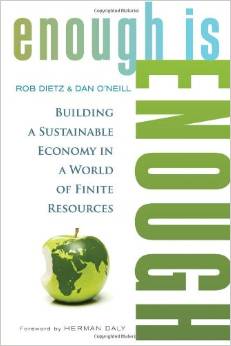
A visionary but realistic alternative to the perpetual pursuit of economic growth – an economy where the goal is not more but enough.
Om det inte fanns skulder i vårt finansiella system skulle det inte finnas några pengar.